Rundown: Fred's $1M Bitcoin bet, Binance a week after the $6.3B hack, freezable stablecoins, a claimed crack of Bitcoin's math, Intel buying Classiq, and a face-off on AI and jobs.
Sources: none.
FredBitcoin
The $1M Bitcoin Bet
$126,210.50
BTC must beat it
Oct 28, 2036
Deadline
Jason said "never." Fred said: bet $1M.
Fred · ~0:30
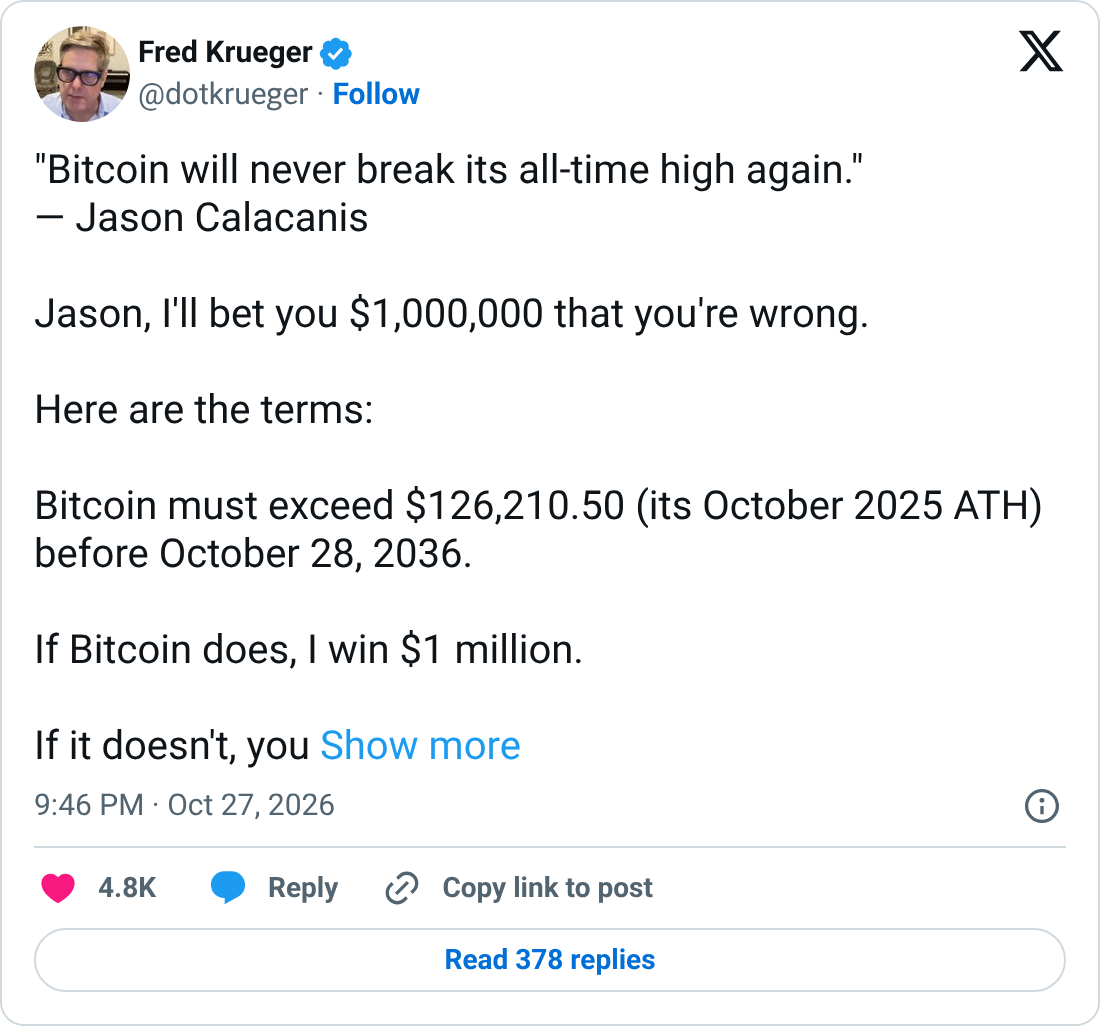
Set-up: Fred challenged Jason Calacanis to bet $1M that Bitcoin goes above $126,210.50 (its October 2025 all-time high) before Oct 28, 2036.
Next two slides show the posts. Then Fred's talking points.
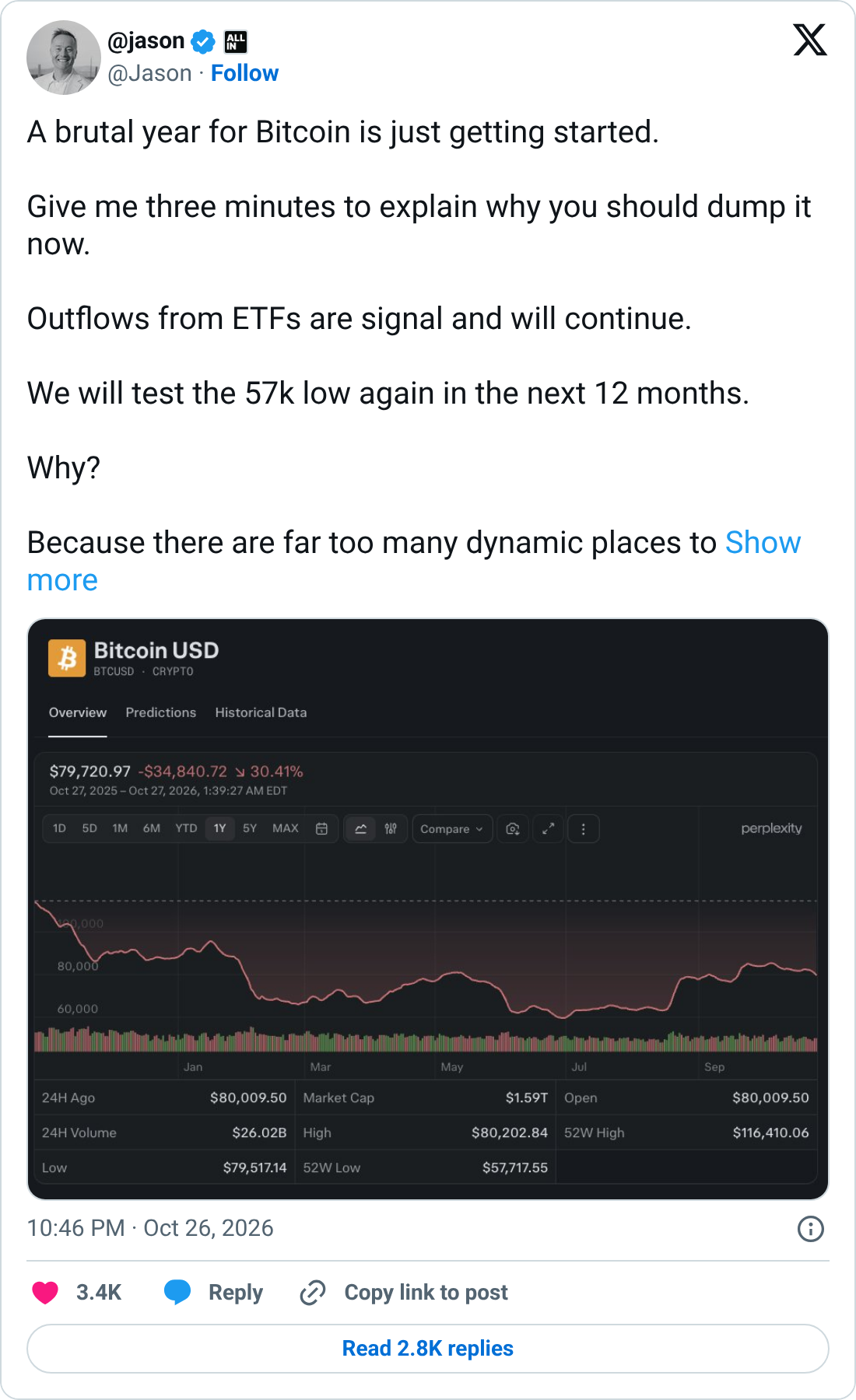
Left: Jason's Oct 26 post (PT), about 2.4M views. It opens "A brutal year for Bitcoin is just getting started. Give me three minutes to explain why you should dump it now." It ends: "Bitcoin will never break its all-time high again."
Fred quoted it the same night: "The idiot has spoken." (about 39K views, 1.4K likes).
Right: Fred's bet, Oct 27 PT (Oct 28 UTC), about 535K views and 4,804 likes. Terms: BTC must exceed $126,210.50 before Oct 28, 2036. Each side puts $1M in independent escrow with an agreed custodian and an objective price oracle. Ends immediately if BTC breaks the record. "You said NEVER. I'm giving you just 10 years."
The cards are cut off where X shows "Show more"; the full text is in these notes.
No lawyers. No escrow agents. $1M USDC each. Chainlink checks the price.
FRED KRUEGER · @dotkrueger53K views · 962 likes
Fred · ~0:45 · real post screenshot
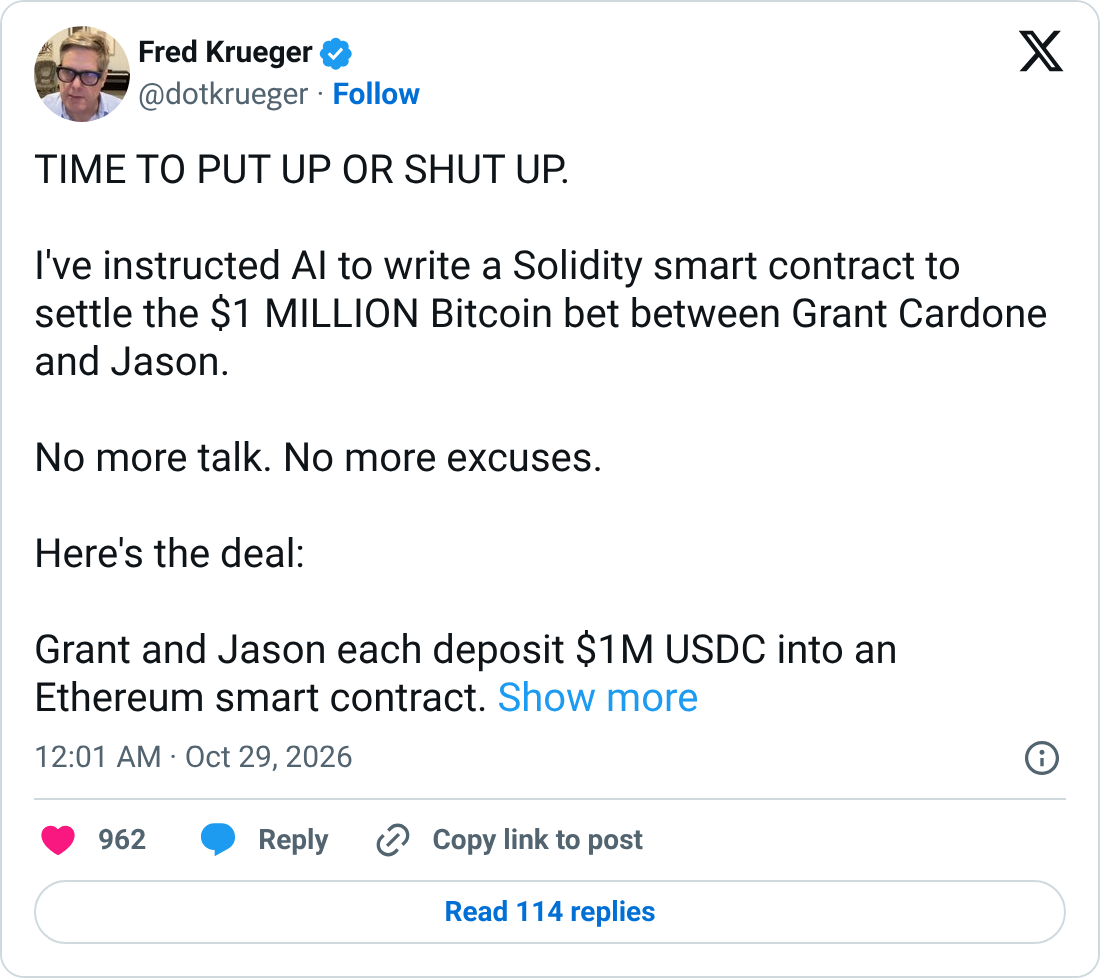
Oct 29: "TIME TO PUT UP OR SHUT UP. I've instructed AI to write a Solidity smart contract to settle the $1 MILLION Bitcoin bet between Grant Cardone and Jason."
Grant and Jason each deposit $1M USDC into an Ethereum smart contract. Chainlink verifies Bitcoin's price. The winner takes the entire $2M.
Fred's own post: "The prototype needs testing and a security audit before deployment."
CHECK This post says the deadline is October 28, 2028, not 2036 as in the original bet. Ben uses this as his counterpoint on the next slide. Ask Fred which date is right.
CounterpointRead the code: the contract post says 2028, not 2036. And it still needs an audit.
Fred, then Ben · ~1:00
Fred (punchy): "Jason said NEVER. Never is a long time. I'm giving him 10 years." Bitcoin only has to beat its own October 2025 high of $126,210.50 once before Oct 28, 2036. Independent escrow, an agreed custodian, an objective price oracle. "No excuses. No moving the goalposts." Then the twist: an AI-written Solidity contract, with Grant Cardone ready to take the Bitcoin side.
Ben (measured): I love settling bets in code, but read the code first. The contract post says October 28, 2028, and the original bet says 2036. Which one is it? Fred himself says the prototype needs testing and a security audit. Who audits it, and what happens if the Chainlink feed fails?
These talking points are drafts in each host's voice. Adjust them freely.
Withdrawals resumed in phases. Coverage is about 95% of the $6.3B. The FBI attributed the hack to North Korea's TraderTraitor unit. About $3B was frozen, mostly stablecoins. About $2.4B in BTC and ETH can't be frozen.
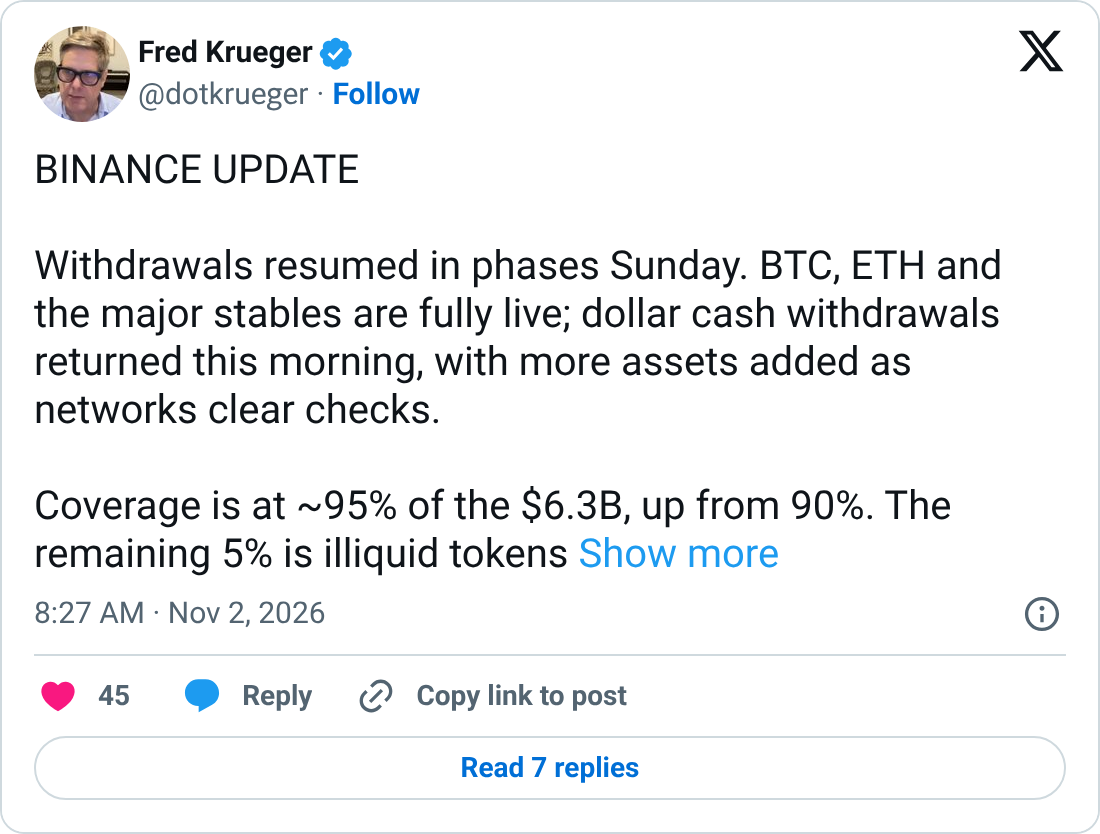
BINANCE UPDATE (Nov 2): Withdrawals resumed in phases Sunday. BTC, ETH and the major stables are fully live; dollar cash withdrawals returned this morning.
Coverage is about 95% of the $6.3B, up from 90%. The remaining 5% is illiquid tokens still being sourced.
The Saturday proof-of-reserves snapshot is verifiable: the top 10 assets are backed at least 1:1. A wider snapshot lands Wednesday; the full proof is expected Nov 3.
Net outflows are about $4.72B since reopening, about 2.8% of platform assets, and stabilizing.
Paid from the corporate treasury, SAFU, and part of the futures insurance fund. SAFU's Bitcoin wallet was tapped for 7,499 BTC and now holds about 7,500 BTC.
The FBI confirmed North Korea's TraderTraitor unit and published 628 addresses to block. About $3B was frozen, mostly stables. The ~$2.4B in BTC and ETH has no freeze net.
"Still owed: the technical post-mortem, including how one engineer's laptop reached a system that could sign away $6.3B in 20 minutes."
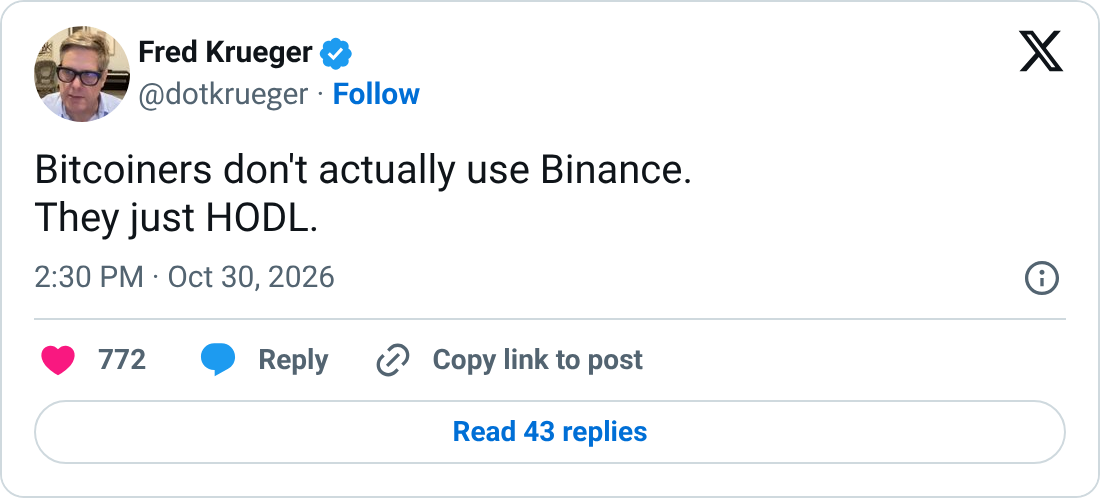
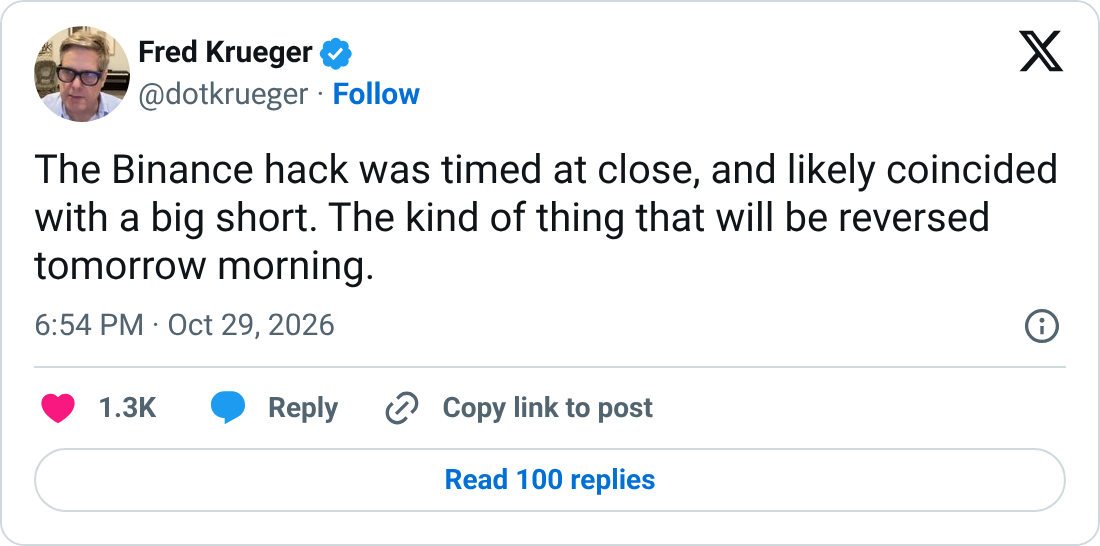
Top right (Oct 30): "Bitcoiners don't actually use Binance. They just HODL." Bottom right (Oct 29): "The Binance hack was timed at close, and likely coincided with a big short. The kind of thing that will be reversed tomorrow morning."
The update card is cut off where X shows "Show more"; the full text is above.
Withdrawals are back, in phases. BTC and ETH live.
~95% of $6.3B covered, up from 90%.
FBI: North Korea's TraderTraitor.
~$3B frozen. The ~$2.4B in BTC + ETH? Gone.
Bitcoiners don't use Binance. They HODL.
BEN
CounterpointCoverage isn't a post-mortem. How did one laptop reach the signer?
Fred, then Ben · ~1:00
Fred: They're paying it back: about 95% of $6.3B covered, from treasury, SAFU and the futures insurance fund. The FBI pinned it on North Korea's TraderTraitor. Here's the lesson: about $3B got frozen because it was mostly stablecoins. The ~$2.4B in BTC and ETH? No freeze net. And real Bitcoiners weren't hurt, because Bitcoiners don't actually use Binance. They just HODL.
Ben: Making users whole is good, but it isn't a post-mortem. Hand off to the next slide: one laptop, $6.3B, 20 minutes.
Why could one laptop reach the signer? Post-mortem still owed.
Ben · ~0:30
From Fred's Nov 2 update: "Still owed: the technical post-mortem, including how one engineer's laptop reached a system that could sign away $6.3B in 20 minutes."
CounterpointOr skip the exchange. Self-custody. Not your keys, not your coins.
Ben, then Fred · ~1:00
Ben (measured): What I want to know end to end is how one engineer's laptop reached a system that could sign away $6.3B in 20 minutes. That's the post-mortem Binance still owes. A system like that should need several independent approvals on isolated machines, so no single device can drain it. The proof-of-reserves snapshot (top 10 assets backed at least 1:1, full proof expected Nov 3) shows solvency. It doesn't show the hole is closed.
Fred: Or skip the whole problem: self-custody.
The security recommendations are general practice, not claims about Binance's actual setup, which hasn't been published.
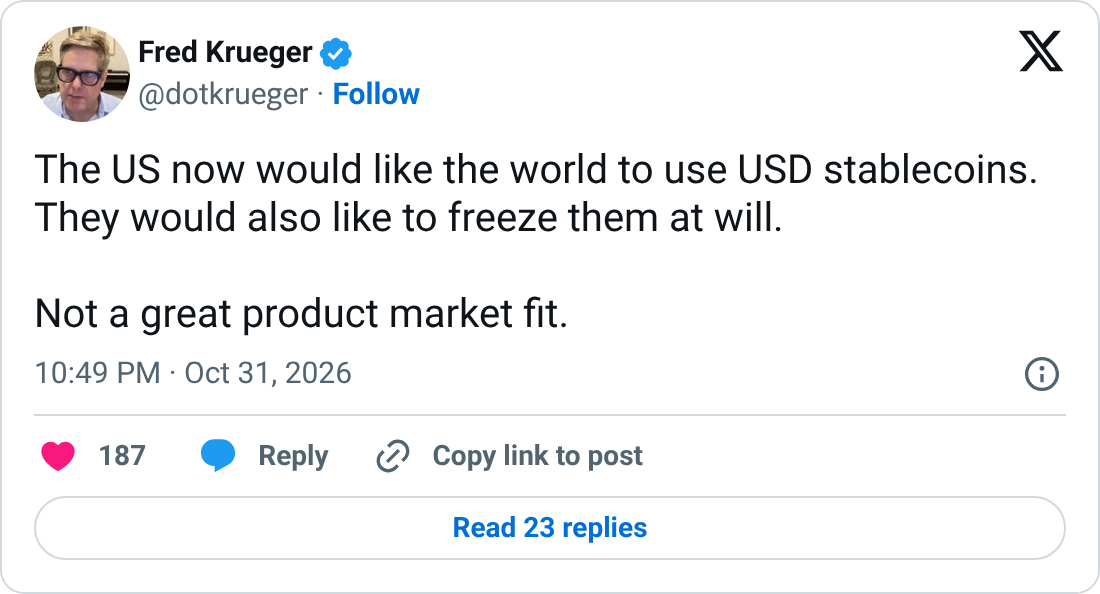
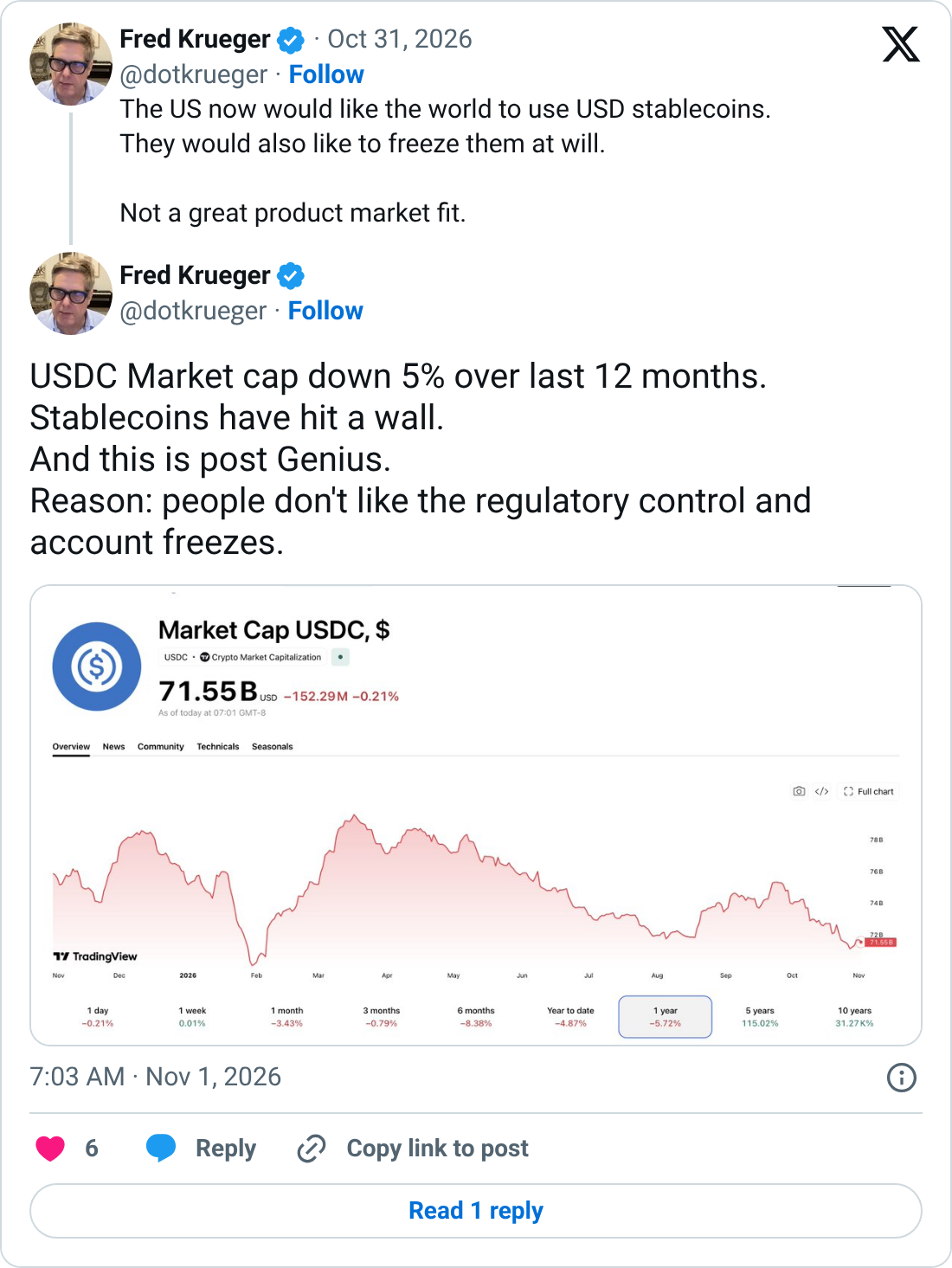
Left (Oct 31 PT): "The US now would like the world to use USD stablecoins. They would also like to freeze them at will. Not a great product market fit." About 16.9K views, 187 likes.
Right (Nov 1, a reply with a USDC market-cap chart): "USDC Market cap down 5% over last 12 months. Stablecoins have hit a wall. And this is post Genius. Reason: people don't like the regulatory control and account freezes."
The −5% figure is Fred's, from his chart. It hasn't been checked independently.
CounterpointFreezes are why ~$3B of the Binance haul got stopped. That's the trade-off.
Fred, then Ben · ~1:00
Fred (contrarian): "Not a great product market fit." You can't sell the world a dollar you can switch off. USDC's market cap is down 5% over 12 months, and that's after the GENIUS Act. People don't like regulatory control and account freezes. Bitcoin can't be frozen.
Ben: Freezability cuts both ways. In the Binance hack, about $3B of the stolen funds was frozen, mostly stablecoins, while the ~$2.4B in BTC and ETH had no freeze net. Users choose that trade-off; it isn't automatically a bug.
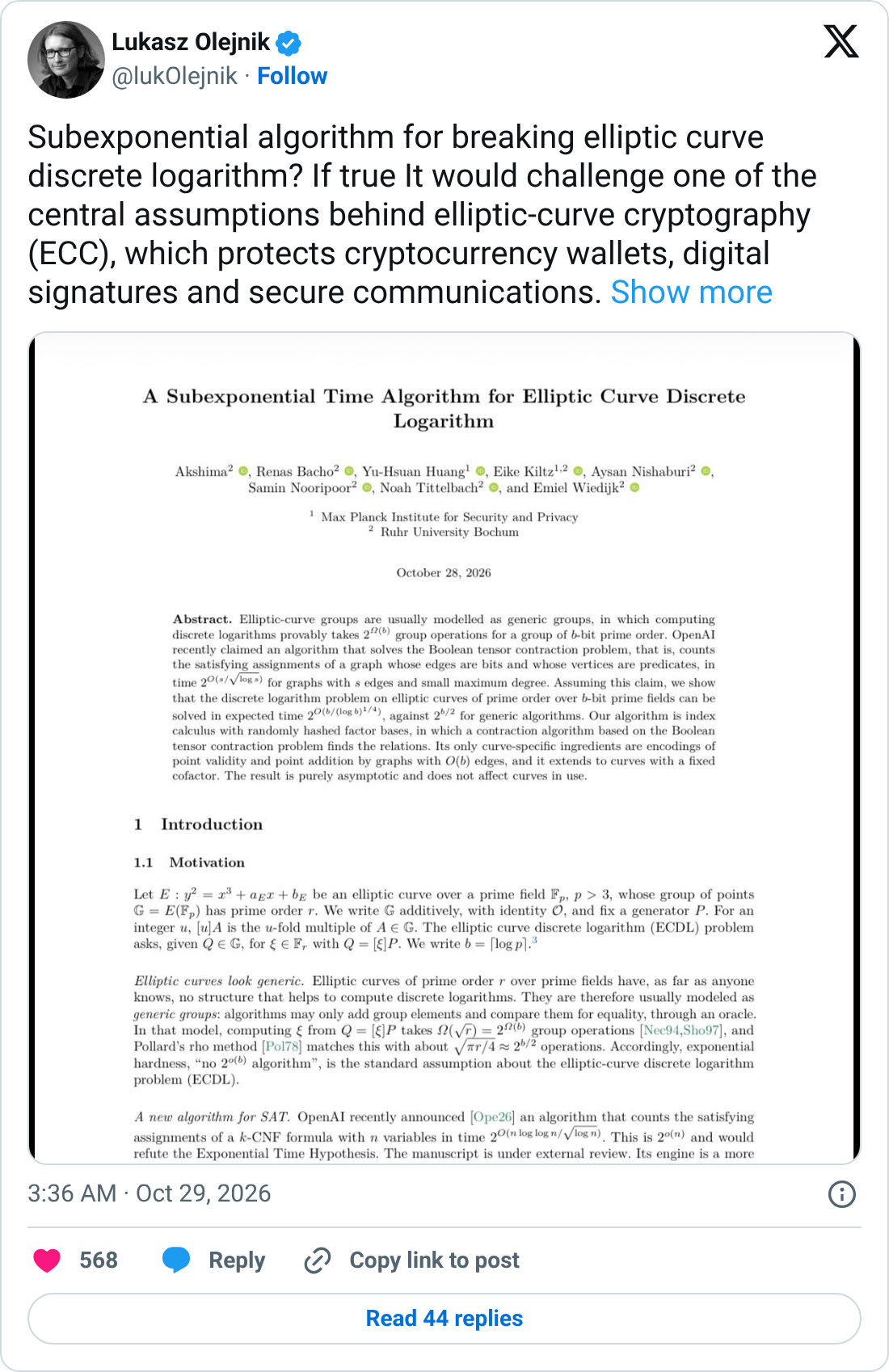
A paper, "A Subexponential Time Algorithm for Elliptic Curve Discrete Logarithm," was released on GitHub dated Oct 28, 2026. Authors: Akshima, Renas Bacho, Yu-Hsuan Huang, Eike Kiltz, Aysan Nishaburi, Samin Nooripoor, Noah Tittelbach and Emiel Wiedijk (Ruhr University Bochum and the Max Planck Institute for Security and Privacy).
Today's best generic attack, Pollard's rho, needs about 2^128 operations on a 256-bit curve.
"Subexponential" is a claim about how cost grows as keys get bigger, not about today's keys. The crossover point is far beyond any curve in use. secp256k1 is untouched.
Chart is illustrative, not to scale.
Status: the paper's existence and its own stated limitation were checked via Steven Galbraith's ellipticnews post. The result itself is not peer-reviewed. Galbraith says he did not check the details.
The result is asymptotic and conditional. It says nothing about P-256 or Ed25519.THE PAPER · VIA LUKASZ OLEJNIK, @lukOlejnik~62K views · 568 likes
Ben · ~0:30 · real post screenshot
Olejnik (Oct 29): "Subexponential algorithm for breaking elliptic curve discrete logarithm? If true It would challenge one of the central assumptions behind elliptic-curve cryptography (ECC), which protects cryptocurrency wallets, digital signatures and secure communications." About 62K views, 568 likes.
From the paper: "Limitations. The result is asymptotic and conditional. The proof of Theorem 2 in [Ope26] yields a saving only for networks of size at least 2^(2^17), so the algorithm says nothing about curves such as P-256 and Ed25519." The second line on the slide paraphrases it.
The paper relies on OpenAI's recent claimed disproof of the Exponential Time Hypothesis (the boolean tensor contraction algorithm), which is also not peer-reviewed.
CounterpointEvery "Bitcoin is broken" headline ends up a buying opportunity.
Ben, then Fred · ~1:00
Ben (hype-skeptical): Ask what this actually changes end to end. It's a real paper from Ruhr University Bochum and Max Planck, and it's mathematically interesting because elliptic curves turn out not to be "generic." But by the paper's own words, the savings only kick in at sizes of at least 2^(2^17). For secp256k1, Pollard's rho is still about 2^128 operations. Nothing changes for today's wallets. The quantum threat is the one to track, and that's what quantumrekt.com is for.
Fred: Every "Bitcoin is broken" headline ends up a buying opportunity. (His opinion; let him phrase it.)
Not qubits. Software. Price reported, not disclosed by Intel.
Ben · ~0:30 · DEAL CONFIRMEDPRICE REPORTED
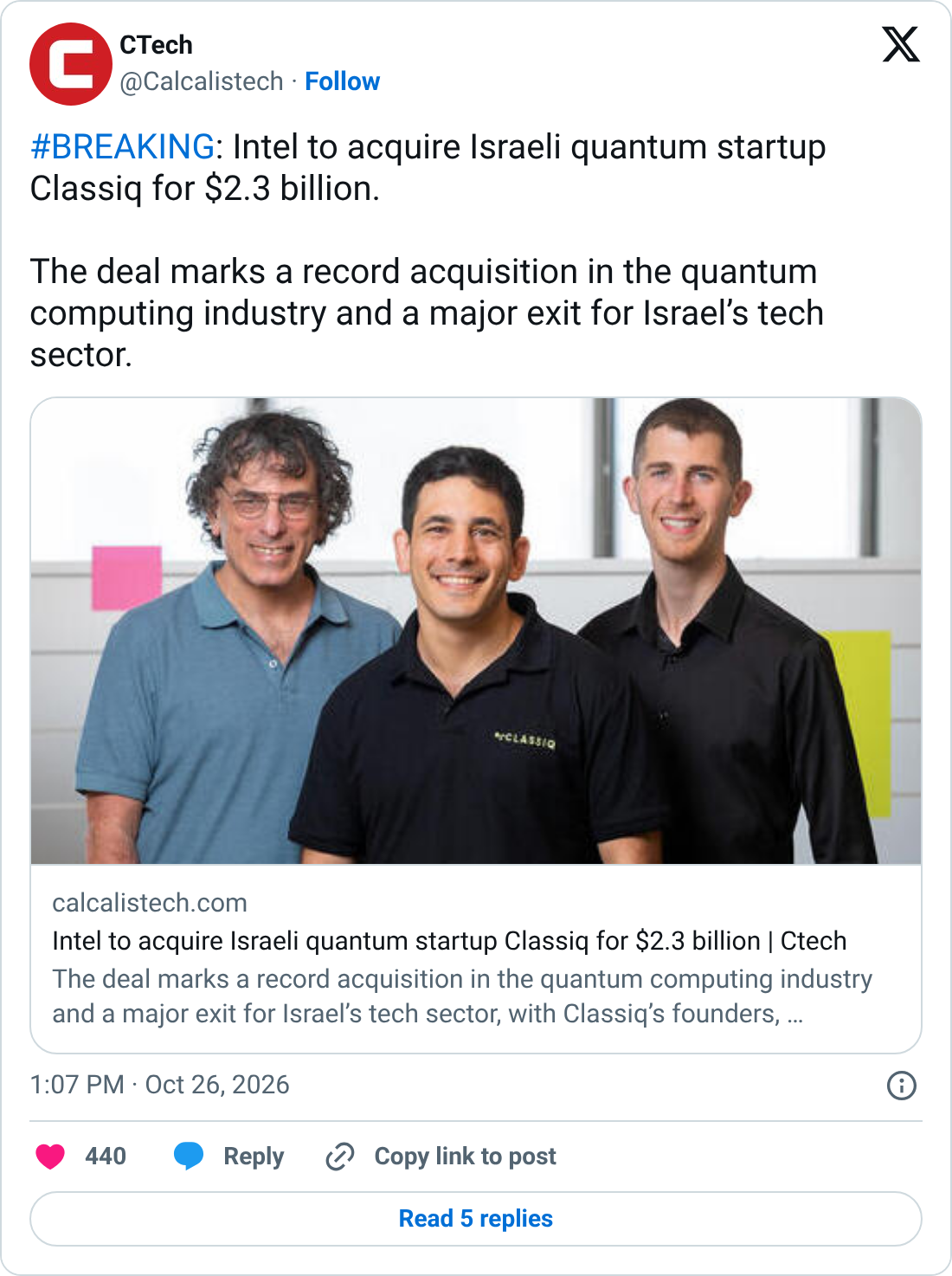
Confirmed: Intel's Oct 26, 2026 press release, "Intel to Acquire Classiq to Create a Full-stack Quantum Computing Platform." The deal is expected to close in the first half of 2027, subject to regulatory approvals.
The ~$2.3B price is not in Intel's release. Calcalist (CTech) reported it first, and Bloomberg reported "about $2.3 billion" citing people familiar with the matter. Say "reported" on air.
A full-stack quantum computing platform. Expected to close in the first half of 2027.INTEL PRESS RELEASE · OCT 26Post: CTech (Calcalist) · 40K views · 440 likes
Ben · ~0:30 · real post screenshot
CTech (Calcalist's English site), Oct 26: "#BREAKING: Intel to acquire Israeli quantum startup Classiq for $2.3 billion. The deal marks a record acquisition in the quantum computing industry and a major exit for Israel's tech sector." About 40K views, 440 likes.
The pull quote is from the title of Intel's press release ("...Create a Full-stack Quantum Computing Platform"). The closing timeline is from the same release.
CounterpointBig money is chasing quantum. Bitcoin should upgrade before it matters.
Ben, then Fred · ~1:00
Ben: This is real: Intel's own release, dated Oct 26. Intel didn't give a price; the ~$2.3B figure is from Calcalist and Bloomberg sources. What Intel is buying is software, specifically Classiq's algorithm-synthesis platform, to pair with its silicon spin qubits. Money and better tools speed up the field. But end to end, nothing about this deal changes how close anyone is to breaking ECDSA today. Track the actual hardware milestones at quantumrekt.com.
Fred: When Intel spends billions on quantum, Bitcoin should take migration seriously before it's urgent. (His opinion; let him phrase it.)
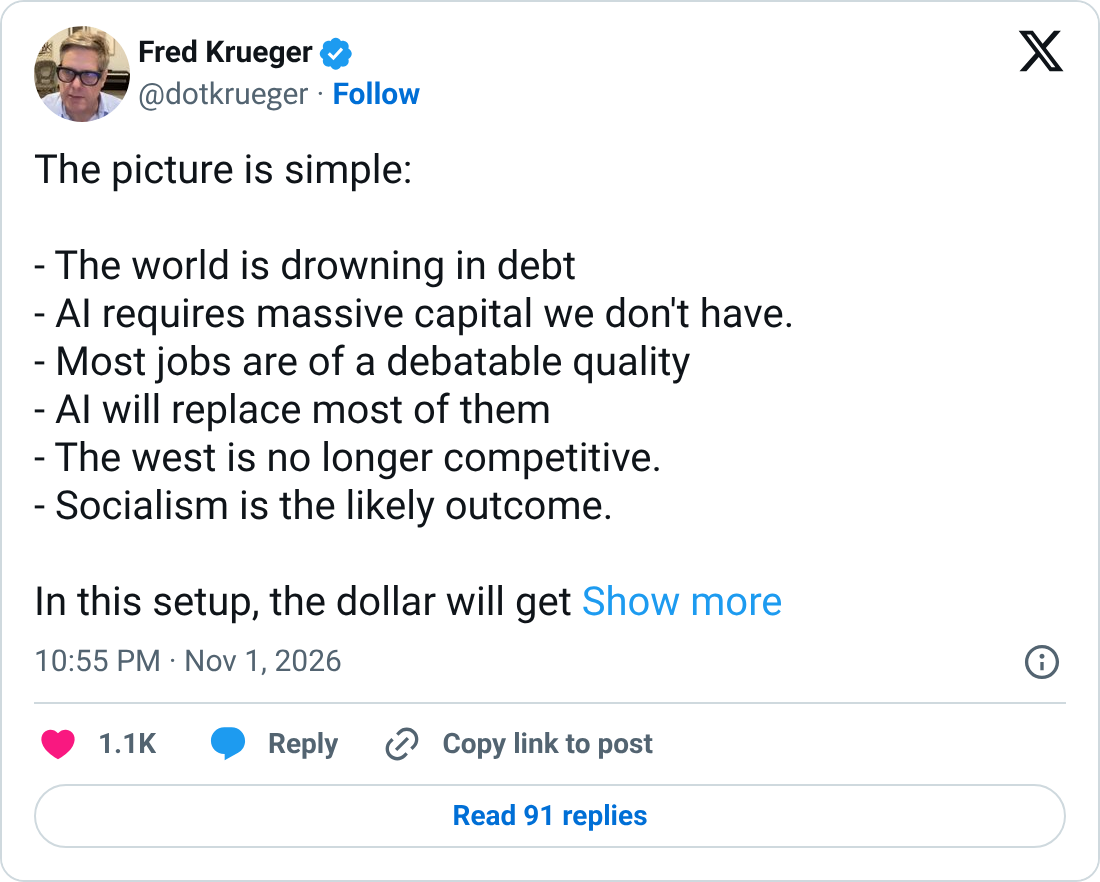
Fred (Nov 1 PT): "The picture is simple: The world is drowning in debt. AI requires massive capital we don't have. Most jobs are of a debatable quality. AI will replace most of them. The west is no longer competitive. Socialism is the likely outcome. In this setup, the dollar will get debased. Inflation will run rampant. Houses will be taxed. You can't print your way out without destroying the value of money. Got Bitcoin?" About 52K views, about 1.1K likes.
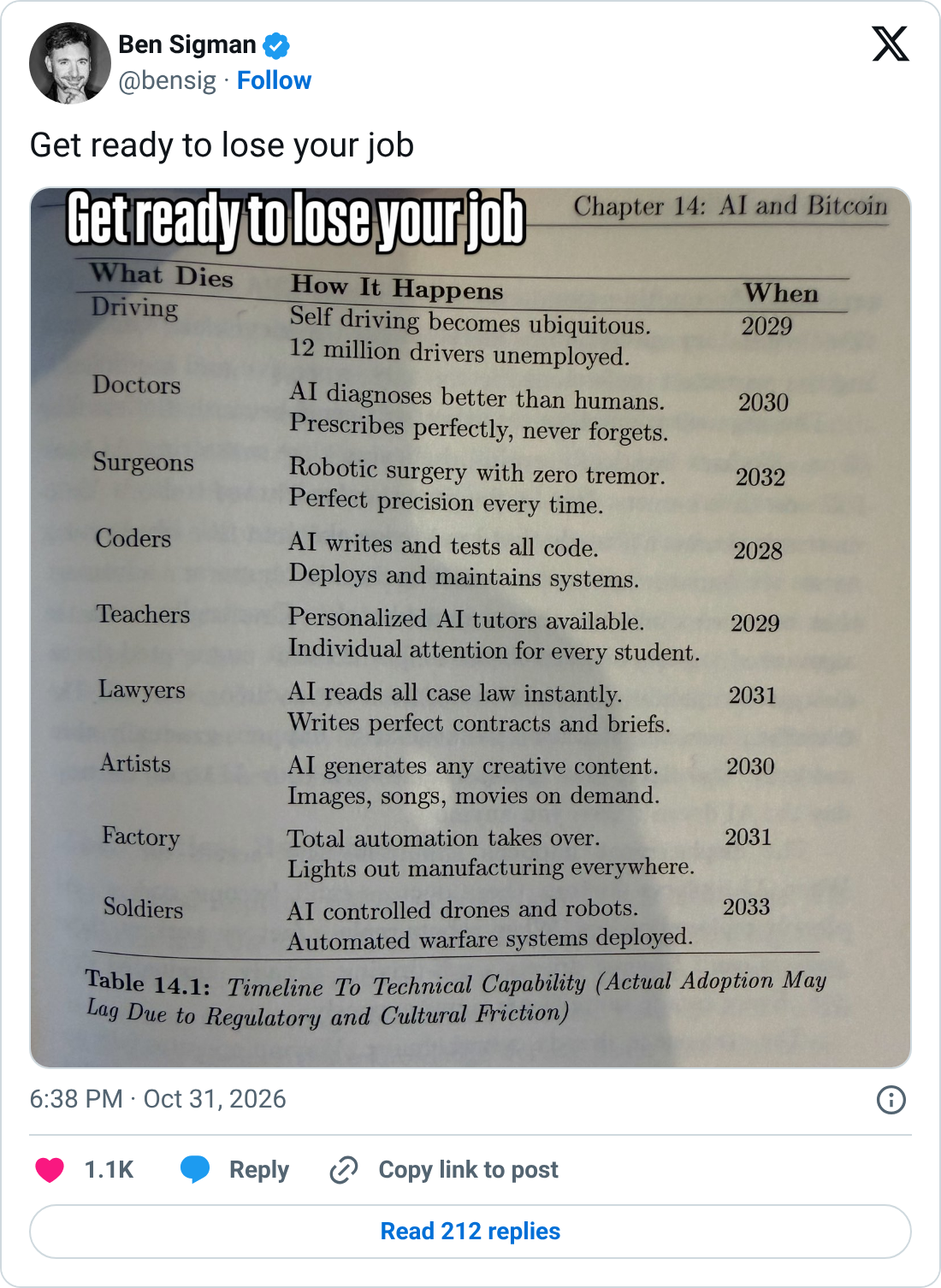
Ben (Oct 31): "Get ready to lose your job" with a book page, "Chapter 14: AI and Bitcoin," Table 14.1 "Timeline To Technical Capability (Actual Adoption May Lag Due to Regulatory and Cultural Friction)". Rows: Driving 2029, Doctors 2030, Surgeons 2032, Coders 2028, Teachers 2029, Lawyers 2031, Artists 2030, Factory 2031, Soldiers 2033. About 417K views, 1,129 likes.
Fred's card is cut off where X shows "Show more"; the full text is above.
Fred (punchy): The world is drowning in debt, AI needs capital we don't have, and AI will replace most jobs. The only way out is printing, and you can't print your way out without destroying the value of money. Got Bitcoin?
Ben (measured): My chart puts technical capability between 2028 (coders) and 2033 (soldiers). But the table's own caption says actual adoption may lag because of regulatory and cultural friction. Capability dates aren't layoff dates. Where do we agree? Where do we disagree?